
Radiology Reporting Efficiency: Why Measurements only Solve 50% of the Workflow
Introduction
Radiologists face various challenges, including the need for greater efficiency and quality in reporting. Implementing structured reporting is widely recognized as a means to improve communication and enhance satisfaction for BOTH referring clinicians and radiologists [1 Radiology]. However, due to the current shortage of radiologists and the increasing volume of imaging studies, there is a pressing need, as described by BenWhite [2 Ben White Blog], for “mass efficiency gains.” In this article, I discuss the importance of both measurement transfer and electronic ultrasound worksheets in ultrasound reporting software to achieve these efficiency gains. It is essential to understand that measurement transfer alone is insufficient to meet the required efficiency gains.
Transferring Measurements and DICOM SR
DICOM Structured Reporting (DICOM SR) provides a standardized format for transferring measurements from modalities like ultrasound and DEXA to other applications. Ultrasound is unique in a couple of ways:
- Sonographers obtain measurements using the modality.
- DICOM SR is the accepted method for transferring measurements from the modality.
For other modalities, a radiologist uses a workstation application and can interact with the reporting package.
Therefore, applications like Imorgon receive measurements from different ultrasound vendors and accurately incorporate them into reporting packages [3 Imorgon Report Accelerator]. This approach enables efficient resource utilization and allows radiologists to focus on image interpretation rather than transcribing numbers, reducing the risk of errors and minimizing dictation time.
Several publications highlight successful implementations of measurement transfer in their institutions, showcasing its benefits and widespread acceptance [4 Current Problems in Diagnostic Radiology] [5 JACR]. Dr. Steve Horii went a step further and estimated the impact of measurement transfer on radiologist reporting time, revealing median reductions of up to 40% for measurement-intensive exams [6 SIIM Presentation].
Ultrasound Worksheets in Modern Ultrasound Reporting Automation
While some institutions exclusively focus on transferring ultrasound measurements, incorporating electronic worksheets alongside measurement transfer offers numerous advantages.
- Reduced likelihood of omitting key sonographer observations, resulting in fewer questions and report creation delays [7].
- Ultrasound worksheet templates serve as checklists for sonographers, enhancing the quality and consistency of observations during exams. A study conducted by Nordin et al. demonstrated the effectiveness of checklists in reducing imaging costs for ultrasound screening of suspected appendicitis in pediatric patients [8]. Over time, the percentage of patients requiring CT scans decreased significantly, resulting in cost savings and reduced radiation exposure.
- Other studies implemented quality improvement processes and observed a decrease in unsupported ultrasound findings [9].
The benefits of ultrasound worksheets apply to all institutions. However, there are particularly significant advantages for young or new sonographers, travelers, or those working after-hours.
Ultrasound Worksheets, Not Just Secondary Captures
It is essential to note that the electronic ultrasound worksheets discussed in this article go beyond scanned paper worksheets stored as images (secondary captures) in the PACS system, which radiologists use to dictate their reports.
Modern ultrasound reporting software provides web-based forms. These forms enable the automatic transfer of consistent, structured sonographer findings into specific fields within a Radiology report.
New Imorgon Research—Ultrasound Worksheets are essential.
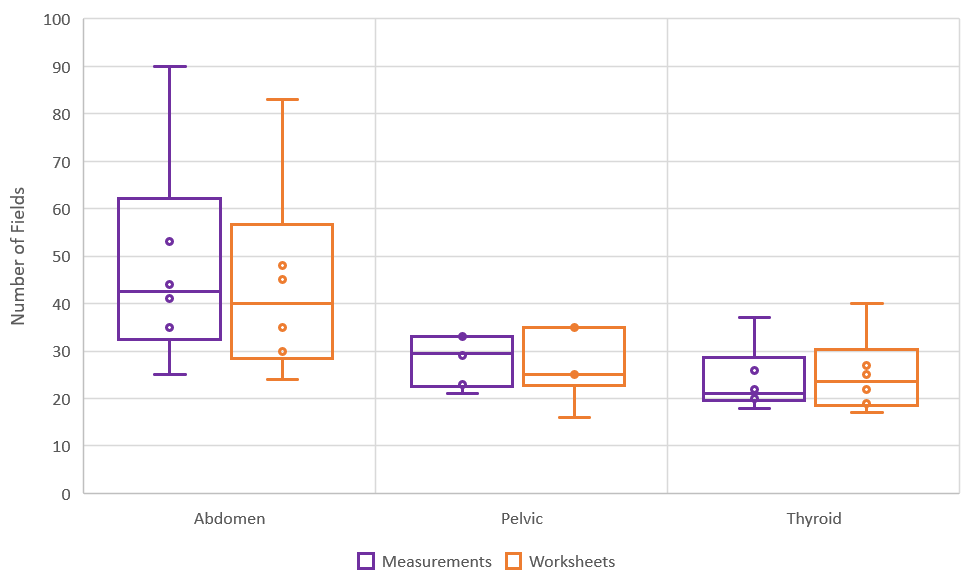
Imorgon investigated various imaging and academic centers to examine the implementation of measurement transfer, sonographer worksheets, and structured reporting. The study focused on the most common examinations performed in hospitals and imaging centers, including Complete Abdominal, Pelvic, and Thyroid examinations. Surprisingly, the findings revealed that approximately 50% of the input fields in radiology reports originated from electronic worksheets, while the remaining 50% were derived from ultrasound system measurements. Notably, no discernible difference was observed between academic and imaging centers.
The first figure depicts that sites tend to have equal measurements and worksheet inputs for a given exam.
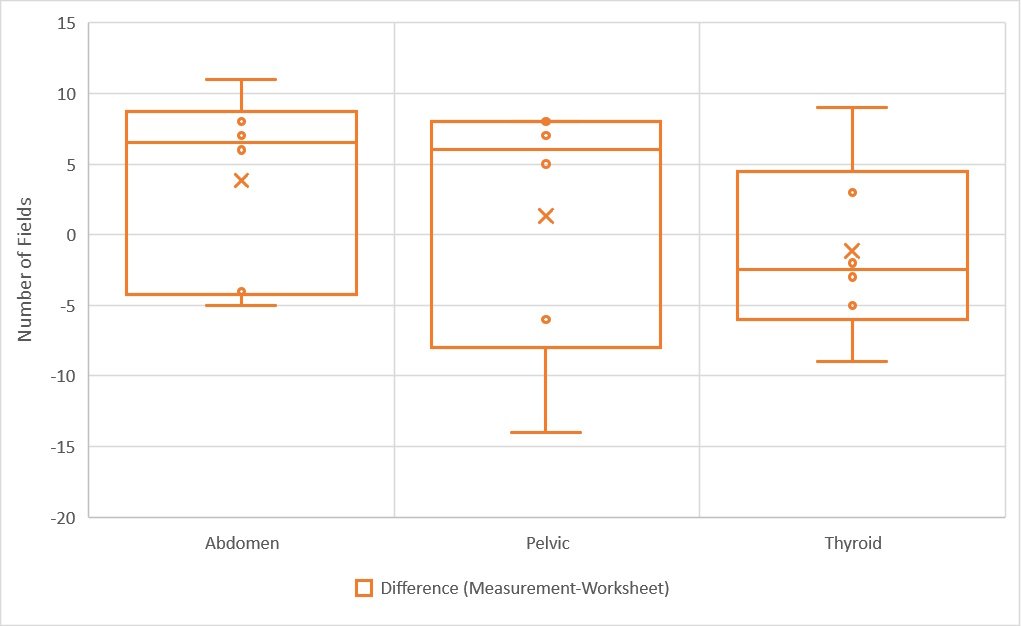
The second graph plots the difference between the number of measurement fields and worksheet fields at a site. It demonstrates that sites that conduct significant measurements also tend to collect numerous worksheet inputs. Hence, irrespective of the total amount of data collected by the sites, both measurements and worksheet data play equally crucial roles.
It is important to note that this investigation did not encompass measurement-intensive Doppler or OB exams, nor non-measurement DVT studies. As a result, results may vary among institutions. Nevertheless, it is reasonable to conclude that sonographer observations from worksheets significantly contribute to generating Radiology reports. [10].
The Path to True [Level 3] Automation
The Path to Level 3 Automation While many institutions remain at Level 2 (standardized picklists and simple measurement transfer), Imorgon’s research highlights why this level underperforms: Because 50% of a standard report consists of qualitative observations—such as echogenicity, nodule texture, or Murphy’s sign—a “measurement-only” solution only automates half of the radiologist’s workload.
To achieve what we define as Level 3: Automated Structured Reporting, an enterprise system must bridge this “qualitative gap”:
- Data Integration: Combine DICOM SR measurements with electronic sonographer worksheets into a single stream.
- Workflow Synchronization: Automatically pre-fill both quantitative and qualitative findings into Nuance PowerScribe or Fluency templates.
- Clinical Decision Support: Use integrated logic (like ACR TI-RADS™) to convert those worksheet observations into final diagnostic impressions.
Summary of Ultrasound Worksheets and Ultrasound Reporting Software
Achieving Level 3 Excellence in Structured reporting is being implemented to enhance the quality and effectiveness of radiology reporting. However, many sites fail to realize the productivity and quality benefits of embracing measurement transfer and electronic worksheets. Understanding that significant improvements in reporting productivity necessitate incorporating both measurement transfer and electronic worksheets is crucial. By doing so, radiologists can realize “mass efficiency gains” and optimize their reporting processes, benefiting patients, referring clinicians, and their well-being.
 Andy Milkowski
Andy Milkowski
Andy Milkowski
One response to “Radiology Reporting Efficiency: Why Measurements only Solve 50% of the Workflow”
-
I would love to discuss it with you
- Schwartz LH, Panicek DM, Berk AR, Li Y, Hricak H. Improving communication of diagnostic radiology findings through structured reporting. Radiology. 2011 Jul;260(1):174-81. doi: 10.1148/radiol.11101913
- The Radiologist Shortage is Here | Ben White [Website Blog]
- Imorgon Report Accelerator [Webpage]
- Scheinfeld MH, Kaplun O, Simmons NA, Sterman J, Goldberg-Stein S. Implementing a Software Solution Across Multiple Ultrasound Vendors to Auto-fill Reports with Measurement Values. Curr Probl Diagn Radiol. 2019;48(3):216-219. doi:10.1067/j.cpradiol.2018.09.002
- Hangiandreou, N., Stekel, S., Tradup, D. Comprehensive Clinical Implementation of DICOM Structured Reporting Across a Radiology Ultrasound Practice: Lessons Learned - Journal of the American College of Radiology. 2016. https://doi.org/10.1016/j.jacr.2016.09.046
- Horii, S. (Article)
- Doyon, V., Tuomi, S., King, C. Best Practice in Standardized Ultrasound Reporting. The Canadian Journal of Medical Sonography. Vol. 13 No. 1 (2022) (jsonocan.com)
- Nordin, A., Sales, S., Nielson, J., Adler, B., Bates, D., Kenney, B. Standardized ultrasound templates for diagnosing appendicitis reduce annual imaging costs. Journal of Surgical Research. 2018;222:77-83. doi.org/10.1016/j.jss.2017.07.002
- Schenone, M., Ziebarth, S., Duncan, J., Stokes, L., Hernandez, A. Effects of a proposed quality improvement process in the proportion of the reported ultrasound findings unsupported by stored images. The Journal of Maternal-Fetal & Neonatal Medicine. 2019. 32:14, 2328-2331, DOI: 10.1080/14767058.2018.1432587
- Imorgon Reporting Automation Investigation across multiple imaging and academic centers (unpublished data)
Leave a Reply